 Add to Chrome
 Add to Firefox
 Add to Edge
Solar power generation prediction
Papers and Code
Probabilistic Multi-Regional Solar Power Forecasting with Any-Quantile Recurrent Neural Networks
Feb 05, 2026
The increasing penetration of photovoltaic (PV) generation introduces significant uncertainty into power system operation, necessitating forecasting approaches that extend beyond deterministic point predictions. This paper proposes an any-quantile probabilistic forecasting framework for multi-regional PV power generation based on the Any-Quantile Recurrent Neural Network (AQ-RNN). The model integrates an any-quantile forecasting paradigm with a dual-track recurrent architecture that jointly processes series-specific and cross-regional contextual information, supported by dilated recurrent cells, patch-based temporal modeling, and a dynamic ensemble mechanism. The proposed framework enables the estimation of calibrated conditional quantiles at arbitrary probability levels within a single trained model and effectively exploits spatial dependencies to enhance robustness at the system level. The approach is evaluated using 30 years of hourly PV generation data from 259 European regions and compared against established statistical and neural probabilistic baselines. The results demonstrate consistent improvements in forecast accuracy, calibration, and prediction interval quality, underscoring the suitability of the proposed method for uncertainty-aware energy management and operational decision-making in renewable-dominated power systems.

SolarGPT-QA: A Domain-Adaptive Large Language Model for Educational Question Answering in Space Weather and Heliophysics
Jan 17, 2026Solar activity, including solar flares, coronal mass ejections (CMEs), and geomagnetic storms, can significantly impact satellites, aviation, power grids, data centers, and space missions. Extreme solar events can cause substantial economic damage if not predicted in advance, highlighting the importance of accurate forecasting and effective education in space science. Although large language models (LLMs) perform well on general tasks, they often lack domain-specific knowledge and pedagogical capability to clearly explain complex space science concepts. We introduce SolarGPT-QA, a question answering system based on a domain-adapted large language model built on the LLaMA-3 base model. The model is trained using scientific literature and large-scale question-answer data generated with GPT-4 and refined using Grok-3 in a student-friendly storytelling style. Human pairwise evaluations show that SolarGPT-QA outperforms general-purpose models in zero-shot settings and achieves competitive performance compared to instruction-tuned models for educational explanations in space weather and heliophysics. A small pilot student comprehension study further suggests improved clarity and accessibility of the generated explanations. Ablation experiments indicate that combining domain-adaptive pretraining with pedagogical fine-tuning is important for balancing scientific accuracy and educational effectiveness. This work represents an initial step toward a broader SolarGPT framework for space science education and forecasting.
Physics-Guided Counterfactual Explanations for Large-Scale Multivariate Time Series: Application in Scalable and Interpretable SEP Event Prediction
Jan 13, 2026Accurate prediction of solar energetic particle events is vital for safeguarding satellites, astronauts, and space-based infrastructure. Modern space weather monitoring generates massive volumes of high-frequency, multivariate time series (MVTS) data from sources such as the Geostationary perational Environmental Satellites (GOES). Machine learning (ML) models trained on this data show strong predictive power, but most existing methods overlook domain-specific feasibility constraints. Counterfactual explanations have emerged as a key tool for improving model interpretability, yet existing approaches rarely enforce physical plausibility. This work introduces a Physics-Guided Counterfactual Explanation framework, a novel method for generating counterfactual explanations in time series classification tasks that remain consistent with underlying physical principles. Applied to solar energetic particles (SEP) forecasting, this framework achieves over 80% reduction in Dynamic Time Warping (DTW) distance increasing the proximity, produces counterfactual explanations with higher sparsity, and reduces runtime by nearly 50% compared to state-of-the-art baselines such as DiCE. Beyond numerical improvements, this framework ensures that generated counterfactual explanations are physically plausible and actionable in scientific domains. In summary, the framework generates counterfactual explanations that are both valid and physically consistent, while laying the foundation for scalable counterfactual generation in big data environments.
Intraday spatiotemporal PV power prediction at national scale using satellite-based solar forecast models
Jan 08, 2026We present a novel framework for spatiotemporal photovoltaic (PV) power forecasting and use it to evaluate the reliability, sharpness, and overall performance of seven intraday PV power nowcasting models. The model suite includes satellite-based deep learning and optical-flow approaches and physics-based numerical weather prediction models, covering both deterministic and probabilistic formulations. Forecasts are first validated against satellite-derived surface solar irradiance (SSI). Irradiance fields are then converted into PV power using station-specific machine learning models, enabling comparison with production data from 6434 PV stations across Switzerland. To our knowledge, this is the first study to investigate spatiotemporal PV forecasting at a national scale. We additionally provide the first visualizations of how mesoscale cloud systems shape national PV production on hourly and sub-hourly timescales. Our results show that satellite-based approaches outperform the Integrated Forecast System (IFS-ENS), particularly at short lead times. Among them, SolarSTEPS and SHADECast deliver the most accurate SSI and PV power predictions, with SHADECast providing the most reliable ensemble spread. The deterministic model IrradianceNet achieves the lowest root mean square error, while probabilistic forecasts of SolarSTEPS and SHADECast provide better-calibrated uncertainty. Forecast skill generally decreases with elevation. At a national scale, satellite-based models forecast the daily total PV generation with relative errors below 10% for 82% of the days in 2019-2020, demonstrating robustness and their potential for operational use.
Accounting for Optimal Control in the Sizing of Isolated Hybrid Renewable Energy Systems Using Imitation Learning
Jan 07, 2026Decarbonization of isolated or off-grid energy systems through phase-in of large shares of intermittent solar or wind generation requires co-installation of energy storage or continued use of existing fossil dispatchable power sources to balance supply and demand. The effective CO2 emission reduction depends on the relative capacity of the energy storage and renewable sources, the stochasticity of the renewable generation, and the optimal control or dispatch of the isolated energy system. While the operations of the energy storage and dispatchable sources may impact the optimal sizing of the system, it is challenging to account for the effect of finite horizon, optimal control at the stage of system sizing. Here, we present a flexible and computationally efficient sizing framework for energy storage and renewable capacity in isolated energy systems, accounting for uncertainty in the renewable generation and the optimal feedback control. To this end, we implement an imitation learning approach to stochastic neural model predictive control (MPC) which allows us to relate the battery storage and wind peak capacities to the emissions reduction and investment costs while accounting for finite horizon, optimal control. Through this approach, decision makers can evaluate the effective emission reduction and costs of different storage and wind capacities at any price point while accounting for uncertainty in the renewable generation with limited foresight. We evaluate the proposed sizing framework on a case study of an offshore energy system with a gas turbine, a wind farm and a battery energy storage system (BESS). In this case, we find a nonlinear, nontrivial relationship between the investment costs and reduction in gas usage relative to the wind and BESS capacities, emphasizing the complexity and importance of accounting for optimal control in the design of isolated energy systems.
Electricity Price Forecasting: Bridging Linear Models, Neural Networks and Online Learning
Jan 06, 2026Precise day-ahead forecasts for electricity prices are crucial to ensure efficient portfolio management, support strategic decision-making for power plant operations, enable efficient battery storage optimization, and facilitate demand response planning. However, developing an accurate prediction model is highly challenging in an uncertain and volatile market environment. For instance, although linear models generally exhibit competitive performance in predicting electricity prices with minimal computational requirements, they fail to capture relevant nonlinear relationships. Nonlinear models, on the other hand, can improve forecasting accuracy with a surge in computational costs. We propose a novel multivariate neural network approach that combines linear and nonlinear feed-forward neural structures. Unlike previous hybrid models, our approach integrates online learning and forecast combination for efficient training and accuracy improvement. It also incorporates all relevant characteristics, particularly the fundamental relationships arising from wind and solar generation, electricity demand patterns, related energy fuel and carbon markets, in addition to autoregressive dynamics and calendar effects. Compared to the current state-of-the-art benchmark models, the proposed forecasting method significantly reduces computational cost while delivering superior forecasting accuracy (12-13% RMSE and 15-18% MAE reductions). Our results are derived from a six-year forecasting study conducted on major European electricity markets.
Semi-Supervised Deep Domain Adaptation for Predicting Solar Power Across Different Locations
Aug 06, 2025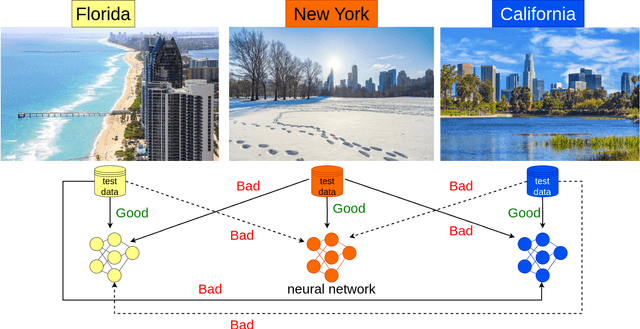

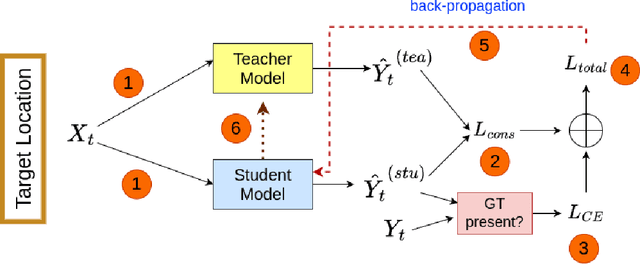
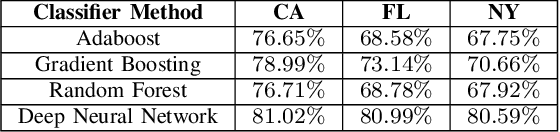
Accurate solar generation prediction is essential for proper estimation of renewable energy resources across diverse geographic locations. However, geographical and weather features vary from location to location which introduces domain shift - a major bottleneck to develop location-agnostic prediction model. As a result, a machine-learning model which can perform well to predict solar power in one location, may exhibit subpar performance in another location. Moreover, the lack of properly labeled data and storage issues make the task even more challenging. In order to address domain shift due to varying weather conditions across different meteorological regions, this paper presents a semi-supervised deep domain adaptation framework, allowing accurate predictions with minimal labeled data from the target location. Our approach involves training a deep convolutional neural network on a source location's data and adapting it to the target location using a source-free, teacher-student model configuration. The teacher-student model leverages consistency and cross-entropy loss for semi-supervised learning, ensuring effective adaptation without any source data requirement for prediction. With annotation of only $20 \%$ data in the target domain, our approach exhibits an improvement upto $11.36 \%$, $6.65 \%$, $4.92\%$ for California, Florida and New York as target domain, respectively in terms of accuracy in predictions with respect to non-adaptive approach.
SolarCrossFormer: Improving day-ahead Solar Irradiance Forecasting by Integrating Satellite Imagery and Ground Sensors
Sep 19, 2025Accurate day-ahead forecasts of solar irradiance are required for the large-scale integration of solar photovoltaic (PV) systems into the power grid. However, current forecasting solutions lack the temporal and spatial resolution required by system operators. In this paper, we introduce SolarCrossFormer, a novel deep learning model for day-ahead irradiance forecasting, that combines satellite images and time series from a ground-based network of meteorological stations. SolarCrossFormer uses novel graph neural networks to exploit the inter- and intra-modal correlations of the input data and improve the accuracy and resolution of the forecasts. It generates probabilistic forecasts for any location in Switzerland with a 15-minute resolution for horizons up to 24 hours ahead. One of the key advantages of SolarCrossFormer its robustness in real life operations. It can incorporate new time-series data without retraining the model and, additionally, it can produce forecasts for locations without input data by using only their coordinates. Experimental results over a dataset of one year and 127 locations across Switzerland show that SolarCrossFormer yield a normalized mean absolute error of 6.1 % over the forecasting horizon. The results are competitive with those achieved by a commercial numerical weather prediction service.
A Hybrid Strategy for Aggregated Probabilistic Forecasting and Energy Trading in HEFTCom2024
May 15, 2025Obtaining accurate probabilistic energy forecasts and making effective decisions amid diverse uncertainties are routine challenges in future energy systems. This paper presents the solution of team GEB, which ranked 3rd in trading, 4th in forecasting, and 1st among student teams in the IEEE Hybrid Energy Forecasting and Trading Competition 2024 (HEFTCom2024). The solution provides accurate probabilistic forecasts for a wind-solar hybrid system, and achieves substantial trading revenue in the day-ahead electricity market. Key components include: (1) a stacking-based approach combining sister forecasts from various Numerical Weather Predictions (NWPs) to provide wind power forecasts, (2) an online solar post-processing model to address the distribution shift in the online test set caused by increased solar capacity, (3) a probabilistic aggregation method for accurate quantile forecasts of hybrid generation, and (4) a stochastic trading strategy to maximize expected trading revenue considering uncertainties in electricity prices. This paper also explores the potential of end-to-end learning to further enhance the trading revenue by adjusting the distribution of forecast errors. Detailed case studies are provided to validate the effectiveness of these proposed methods. Code for all mentioned methods is available for reproduction and further research in both industry and academia.
Benchmarking Deep Learning-Based Methods for Irradiance Nowcasting with Sky Images
Mar 27, 2025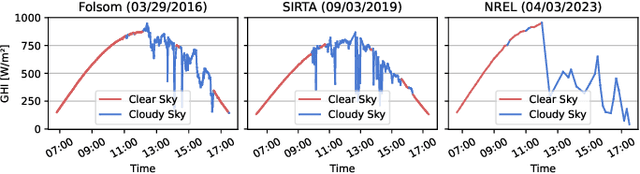
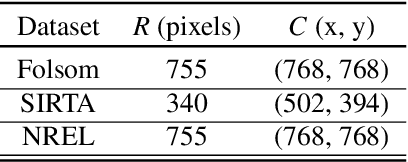
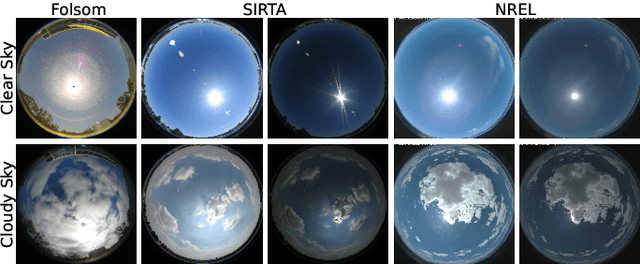
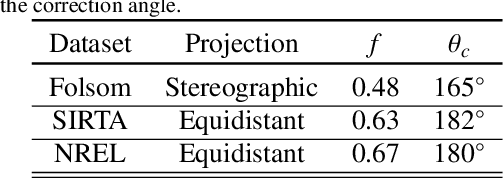
To address the high levels of uncertainty associated with photovoltaic energy, an increasing number of studies focusing on short-term solar forecasting have been published. Most of these studies use deep learning-based models to directly forecast a solar irradiance or photovoltaic power value given an input of sky image sequences. Recently, however, advances in generative modeling have led to approaches that divide the forecasting problem into two sub-problems: 1) future event prediction, i.e. generating future sky images; and 2) solar irradiance or photovoltaic power nowcasting, i.e. predicting the concurrent value from a single image. One such approach is the SkyGPT model, where they show that the potential for improvement is much larger for the nowcasting model than for the generative model. Thus, in this paper, we focus on the solar irradiance nowcasting problem and conduct an extensive benchmark of deep learning architectures across the widely-used Folsom, SIRTA and NREL datasets. Moreover, we perform ablation experiments on different training configurations and data processing techniques, including the choice of the target variable used for training and adjustments of the timestamp alignment between images and irradiance measurements. In particular, we draw attention to a potential error associated with the sky image timestamps in the Folsom dataset and a possible fix is discussed. All our results are reported in terms of both the root mean squared error and the mean absolute error and, by leveraging the three datasets, we demonstrate that our findings are consistent across different solar stations.